40 section 11.2 from dna to protein worksheet answers
9.3 Transcription - Concepts of Biology - 1st Canadian Edition To do this, the DNA is "read" or transcribed into an mRNA molecule. The mRNA then provides the code to form a protein by a process called translation. Through the processes of transcription and translation, a protein is built with a specific sequence of amino acids that was originally encoded in the DNA. 9.5 How Genes Are Regulated - Concepts of Biology - 1st Canadian Edition For a cell to function properly, necessary proteins must be synthesized at the proper time. All organisms and cells control or regulate the transcription and translation of their DNA into protein. The process of turning on a gene to produce RNA and protein is called gene expression. Whether in a simple unicellular organism or in a complex ...
Essential Biology 11.2 Muscles and Movement AHL - SlideShare 2. Outline the antagonistic nature of the action of muscles in the human body, using the elbow as an example. 3. Flexing (bending)ExtendingBicepsTriceps. 4. Compare the action of the hip and knee joints. 5. Hip (similar to shoulder)KneeType of jointBall and socketRange of movementBonesLeverFemurFlex/ effortExtend/ effortImage.
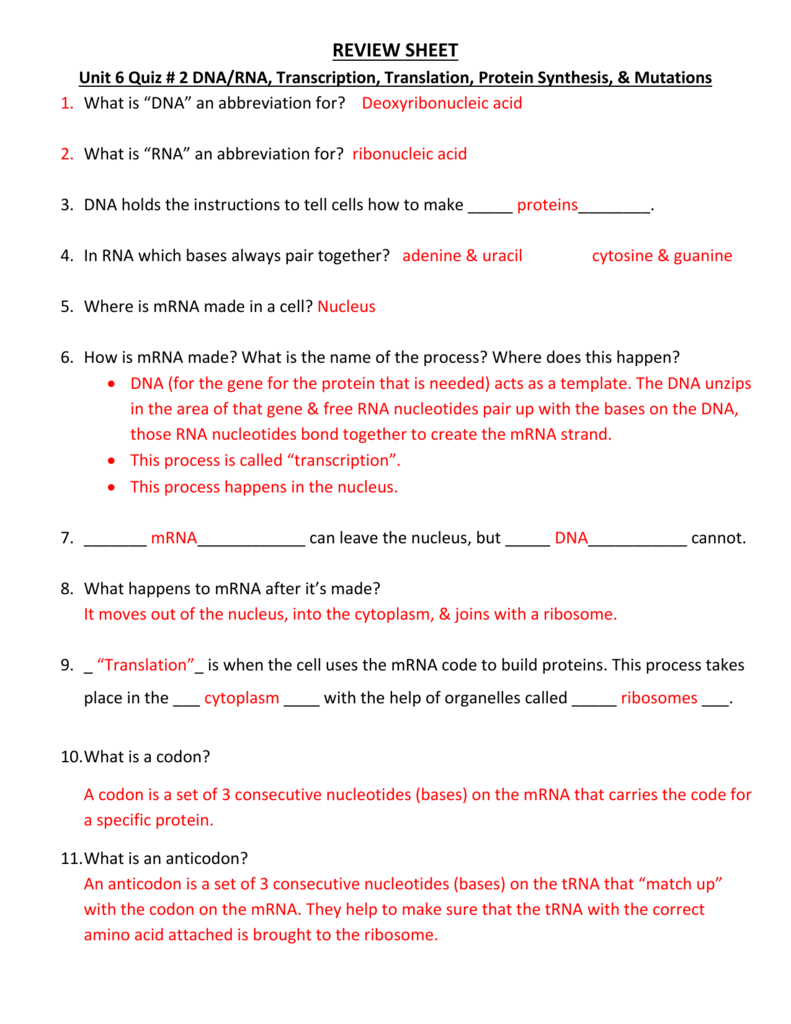
Section 11.2 from dna to protein worksheet answers
Biology 11.1 - phhscience.weebly.com Chapter 11-2 Chapter 11-3 Chapter 12 Chapter 12-1 Chapter 12-2 ... DNA, RNA, and Protein Formation Series of Videos DNA Lecture 18 Things you should know about genetics What is DNA. DNA Structure. DNA Song DNA Replication Lab DNA Extraction Section 11.1 Quiz Direction for making model Paper for model DNA Lab. DNA Starter Activity: File Size ... Topic 2.7: DNA Replication, Transcription and Translation Rule - one base always pairs with another is called complementary base pairing.This makes sure that the two DNA molecules that are created by DNA replication are identical in their base sequences to the parent molecule that was replicated. 2.7.U2 Helicase unwinds the double helix and separates the two strands by breaking hydrogen bonds. Ch. 11 Multiple Choice - Microbiology | OpenStax RNA to DNA to protein DNA to protein to RNA 3. Which of the following is the enzyme that replaces the RNA nucleotides in a primer with DNA nucleotides? DNA polymerase III DNA polymerase I primase helicase 4. Which of the following is not involved in the initiation of replication? ligase DNA gyrase single-stranded binding protein primase 5.
Section 11.2 from dna to protein worksheet answers. Biology 2010 Student Edition - GradeSaver Chapter 11, Introduction to Genetics - 11.1 - The Work of Gregor Mendel - 11.1 Assessment - Page 312: 1c Answer Segregation means that during gamete formation, the alleles of each of the genes separate from one another; therefore, each gamete carries a single allele for each gene. Work Step by Step Section 11.2: From DNA to Protein Flashcards | Quizlet Start studying Section 11.2: From DNA to Protein. Learn vocabulary, terms, and more with flashcards, games, and other study tools. Home. ... 15 answers. QUESTION. how does a ribosome know what protein to make? 6 answers. ... Ch 11.2 Worksheet. 16 terms. WD55. DNA/RNA Whole Unit. 28 terms. Christina_Isaac. Chapter 13 BIO Quiz. 37 terms. Transcription 11.2 Obj. TSW explain the process of Protein ... Why is a codon important to making a protein? ... Section 11.2 Summary – pages 288 - 295 ... Answer. DNA determines the structure of proteins. 9.1 The Structure of DNA - Concepts of Biology - 1st Canadian Edition Now let's consider the structure of the two types of nucleic acids, deoxyribonucleic acid (DNA) and ribonucleic acid (RNA). The building blocks of DNA are nucleotides, which are made up of three parts: a deoxyribose (5-carbon sugar), a phosphate group, and a nitrogenous base ( Figure 9.3 ). There are four types of nitrogenous bases in DNA.
RNA Translation worksheet 18 CH 11 section 11.2 - Quizlet Start studying RNA Translation worksheet 18 CH 11 section 11.2. Learn vocabulary, terms, and more with flashcards, games, and other study tools. PPTX DNA is the only molecule that changes the phenotype of recipient cells ... DNA Structure: practice questions. The following comprehension questions (at end of each chapter section) in Brooker, Concepts of Genetics are recommended: Comprehension Questions (at end of each section):11.2, 11.3, 11.3, 11.5 #2, 11.7, Answers to Comprehension Questions are at the very end of every chapter. Protein Synthesis Review Sheets with Keys.pdf Date Class Reinforcement and Study Guide Section 11.2 From DNA to Proteih Complete the chart on the three chemical differences between DNA and RNA. 1. strand of nucleotides 2. sugar 3. nitrogenous base In your textbook, read about the genetic code. Complete each statement. 4. Proteins are made up of 5. There are twenty different types of 6. PDF CK-12 Biology Quizzes and 11. Science cannot answer all questions. a.The above statement is true because science cannot answer matters of belief. b.The above statement is true because all science is based on logic. c.The above statement is false because science can prove that life evolves over time.
16.1 Regulation of Gene Expression - Biology 2e | OpenStax Figure 16.2 Locations of gene regulation. The regulation of gene expression occurs at multiple steps going from DNA to the functional gene product, usually a protein. It begins with chromatin structure making the DNA more or less accessible for transcription by RNA polymerase. In eukaryotes, the primary mRNA transcript must be processed before ... 11.2 From DNA to Protein Section. 11.2 From DNA to Protein. North Carolina Objectives Objective 3.01 Analyze the molecular basis of heredity including: Protein synthesis. DNA Transciption worksheet 17 ch 11 section 11.2 Biology - Quizlet Terms in this set (8) How many strands of mRNA are transcribed from the two "unzipped" strands of DNA. One stand. What are the three parts of the RNA nucleotide. Phosphate, ribose sugar, and nitrogen base. How does base paring differ in RNA and DNA. DNA the bases that pair are T-A and G-C. in RNA the bases that pair are U-A and G-C. Mrs. Paul - Biology: AP Biology 2017-2018 - Blogger Read and take notes (on a separate piece of paper) Ch 12.1-12.3, write a summary for each section; DNA Reading with Questions and Coloring; 11/16 Due 11/17: Watch the Bozeman Videos for DNA and RNA (Take 1 and Take 2) and answer the study questions; Create a Venn Diagram to compare and contrast DNA and RNA; 11/17 Due 11/20: DNA Extraction Post Lab
From Dna To Protein Worksheet - Worksheet List
Chapter 11: DNA and Genes DNA. 4. Sequence the steps involved in protein synthesis. ... Transparency Worksheets, pp. ... Interactive Chalkboard CD-ROM: Section 11.2 Presentation.
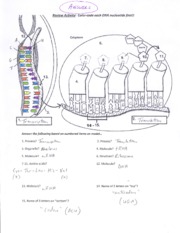
DNA replication Notes - The Role of the Nucleus Significance of DNA DNA ...
Biology - MY SITE Chapter 2: Glencoe Virtual pH lab. Lab 3: Virtual Macro-molecule Lab . Enzyme Action Lab Directions. Enzyme Action Lab Report Template. Chapter 2 Vocabulary Review Part A (Terms 1-22) Chapter 2 Lab: Enzyme Action (RESULTS INPUT) Bozeman Science Video: Atoms and Molecules. Chapter 2 Vocabulary Review Part B (Terms 23-41) Video: Protein Structure.

Chapter 8 From Dna To Proteins Vocabulary Practice Answers : 35 ...
9th Grade Biology - Chapter 11 DNA and Genes, 11.1 - DNA: The molecule ... Double Helix The shape of DNA because it it is composed of two strands DNA replication The process of making copies of DNA. During replication each strand serves as a patter to make a DNA molecule. Messenger RNA RNA that brings information from the DNA in the nucleus to the cell's factory floor, the cytoplasm. (mRNA) Ribosomal RNA
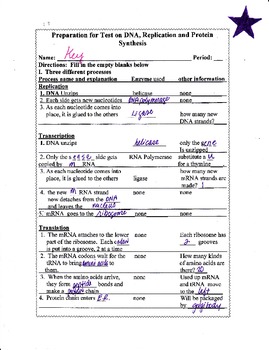
32 From Dna To Protein Worksheet - Worksheet Project List
Chapter 11, Introduction to Genetics - Assessment - GradeSaver Chapter 11, Introduction to Genetics 11.1 - The Work of Gregor Mendel - 11.1 Assessment 11.2 - Applying Medel's Principles - 11.2 Assessment 11.3 - Other Patterns of Inheritance - 11.3 Assessment 11.4 - Meiosis - Analyzing Data 11.4 - Meiosis - 11.4 Assessment Skills Lab - Pre-Lab - Modeling Meiosis

Worksheet On Dna Rna And Protein Synthesis Answer Key - worksheet
DOCX PC\|MAC What is the name of the molecule that completes the flow of information from DNA to protein? How are the nitrogen bases of RNA different from DNA? List two other ways in which RNA is different from DNA. When you finish your notes, complete this diagram comparing DNA and RNA. RNA DNA DNA and RNA Structure Comparison Double Strand Single Strand
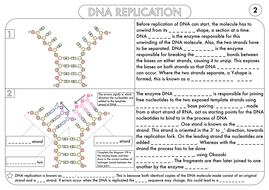
A Level Biology Worksheet Pack on DNA and Protein Synthesis by ...
Biology 2010 Student Edition - GradeSaver Chapter 11, Introduction to Genetics 11.1 - The Work of Gregor Mendel - 11.1 Assessment 11.2 - Applying Medel's Principles - 11.2 Assessment 11.3 - Other Patterns of Inheritance - 11.3 Assessment 11.4 - Meiosis - Analyzing Data 11.4 - Meiosis - 11.4 Assessment Skills Lab - Pre-Lab - Modeling Meiosis

Dna Base Pairing Worksheet Answer Sheet | Biology worksheet ...
DOC Chapter 11 Multiple Choice Practice Test - New Century Academy a. binding induces changes in the cells that lead to cell fusion. b. the cells then produce the a factor and the factor. c. one cell nucleus binds the mating factors and produces a new nucleus in the opposite cell. d. the cell membranes fall apart, releasing the mating factors that lead to new yeast cells. e.
29 Chapter 12 Section 1 Dna The Genetic Material Worksheet Answers ...
Core Bio DNA Review Answers.pdf - Georgetown ISD In your textbook, read about what DNA is and the replication of DNA. Label the diagram. Use these choices: nucleotide, deoxyribose, phosphate group, ...

Chapter 8 From Dna To Proteins Vocabulary Practice Answers / 14 Best ...
Answer Key Chapter 2 - Microbiology | OpenStax Introduction; 24.1 Anatomy and Normal Microbiota of the Digestive System; 24.2 Microbial Diseases of the Mouth and Oral Cavity; 24.3 Bacterial Infections of the Gastrointestinal Tract; 24.4 Viral Infections of the Gastrointestinal Tract; 24.5 Protozoan Infections of the Gastrointestinal Tract; 24.6 Helminthic Infections of the Gastrointestinal Tract; Summary
0 Response to "40 section 11.2 from dna to protein worksheet answers"
Post a Comment